
Pearls is a timeless, elegant piece of jewelry, and two of the most popular types are shell pearl and freshwater pearl. While both of them are timeless, beautiful, and eye-catching, they are distinct in their origin, appearance, size & shape, color & luster, durability.In this article, we will discuss shell pearls vs freshwater pearls, providing clarity on their differences.
Understanding Shell Pearls
What are Shell Pearls?
Shell pearls are man-made shells, and are commonly called “Mother of Pearl.” These types of pearls are imitations of natural pearls. They are formed from the inner lining of oyster shells.

Source: Pinterest
How is Shell Pearl Made?
Shell pearl is made from grinding the insides of oyster shells into powder form. The powder is then shaped into different shapes and sizes. After that, they are colored and coated with natural pearl nacre to create a lustrous and durable surface.
This manufacturing process allows for greater control over shell pearls’ final appearance, allowing for uniform shape, size, and color. A single freshwater mussel can produce up to 50 pearls. That’s why this pearl type is a reasonable option for jewelry pieces needed to resemble natural pearls at a lower price.
Are Shell Pearls Real Pearls?
No, shell pearls are not real pearls. They are man-made pearls created to mimic natural pearls. While they are made using materials from oyster shells, they are not formed organically within a mollusk or oyster. Meanwhile, shell pearls are not plastic pearls, they are much more natural and stunning than plastic pearls, though are more expensive.
Understanding Freshwater Pearls
What is Freshwater Pearl and How is it Made?
Freshwater pearls are pearls formed in freshwater mollusks like mussels found in lakes, rivers, and ponds. They organically form when an irritant like a parasite or grain of sand enters the mollusks. In response, the mollusks form layers of nacre on the irritant. Over time, these layers result in forming a pearl.
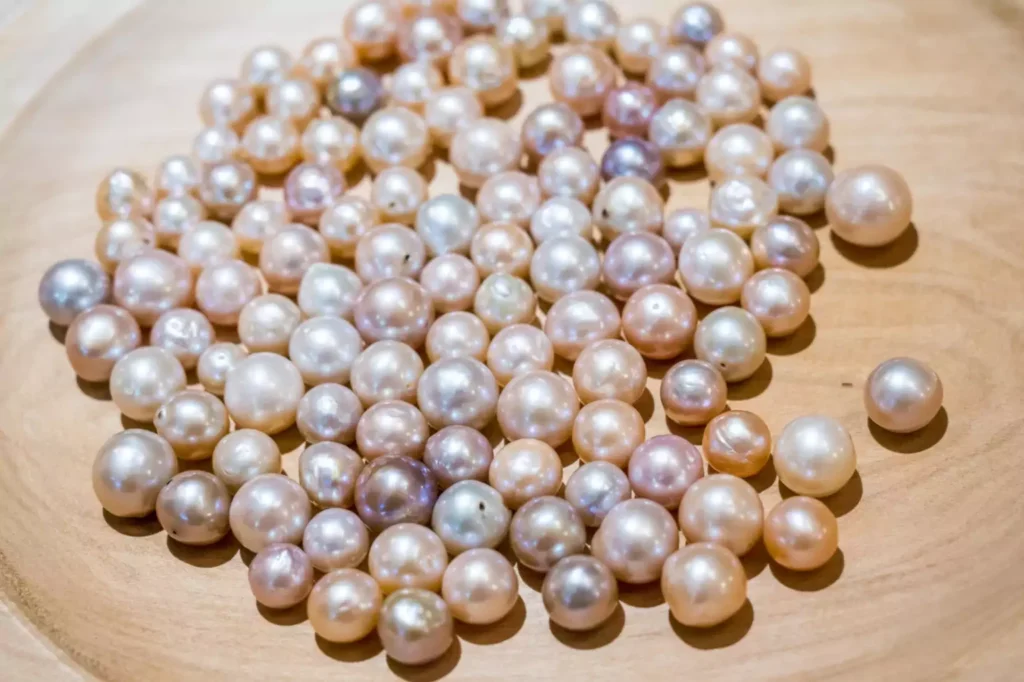
freshwater pearls
Freshwater pearls are in two types: natural freshwater pearl and cultured freshwater pearl.
Natural Freshwater Pearls
Natural freshwater pearls are formed in freshwater mollusks (mussels) rather than oysters. They are extremely rare because they are formed without human intervention. Due to constant fishing and pollution, natural freshwater pearls are becoming increasingly scarce, making them highly valuable.
Cultured Freshwater Pearls
Cultured freshwater pearls are grown artificially in pearl farms. In curated pearls, a small bead is deliberately inserted into the mollusk to propel nacre production. Then, the mollusk is returned to the water, where it will cover the irritant with layers of nacre, resulting in the creation of a pearl.
Cultured freshwater pearls are the most widely produced and cheapest freshwater pearl type today. A single freshwater mussel can produce approximately 40 cultured pearls per harvest. Hence, why most of the freshwater pearls on the market now are cultured.
Where Do Freshwater Pearls Come From?
Freshwater pearls commonly found in easily accessible freshwater in large quantities. The vast majority of freshwater pearls on the market today are from pearl farms in Central and Eastern China. However, a small percentage of pearls are grown in freshwaters and rivers in Japan and the United States of America.
Are Freshwater Pearls Real Pearls?
Yes, freshwater pearls are real pearls directly cultivated to natural pearls. They are made naturally inside freshwater mollusks and oysters that live in lakes and rivers.
Even though the vast majority of freshwater pearls are cultured, they are still real pearls because they are formed with the help of humans and composed of the same nacre as natural freshwater pearls. The only difference is the production conditions they undergo.
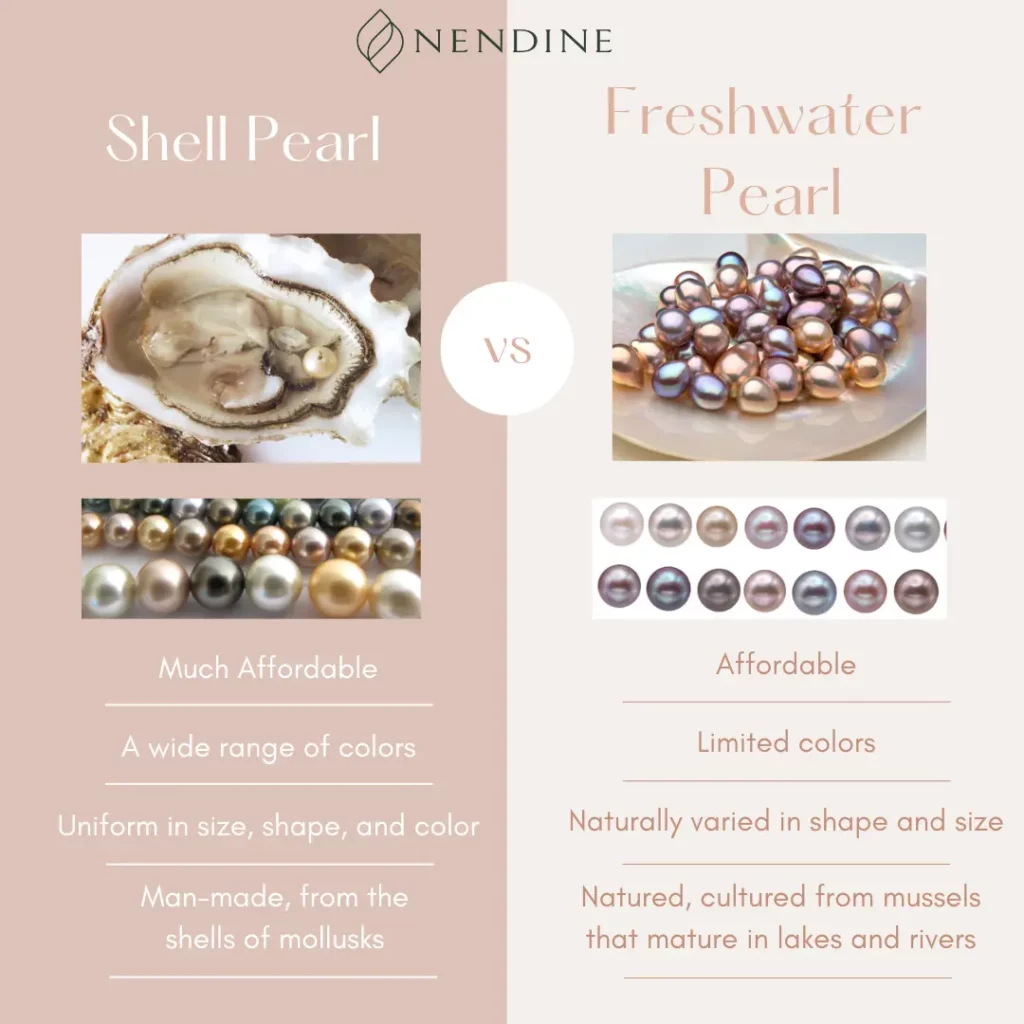
Now, let’s dissect these different types of pearls using key characteristics like their origin, appearance, size & shape, color & luster, durability and price.
Origin
Shell Pearls:
Shell pearls are man-made. These synthetic pearls are derived from the shells of mollusks. They are crafted from beads coated with layers of grounded nacre (mother of pearl), which makes them have the appearance of real pearls.
Freshwater Pearls:
Natural freshwater pearls are formed inside freshwater mussels, typically grown in lakes and rivers. Cultured freshwater pearl is artificially grown in plant farms. These pearls are derived when an irritant enters the mussel, and the mollusk covers it with layers of nacre.
Appearance
Shell Pearls:
Shell pearls are highly uniform in size, shape, and color due to its man-made production process. A sea shell pearl has a smooth, polished surface with uniform coating of nacre, giving it a flawless appearance.
Freshwater Pearls:
Freshwater pearls are naturally available in various shapes and sizes, often with irregularities. They can come in oval, round, or distorted shapes, adding to their organic beauty. These pearls have minor imperfections or dimples on their surface, which signifies their natural formation.
Size and Shape
Shell Pearls:
The difference between mother of pearl and freshwater pearl can also be denoted by their size and shape. Typical sizes of shell pearls found in the market range from 8mm to 16mm. They are generally uniform in shape whether round, oval, or any other shape. Their controlled production ensures perfect symmetry and a refined, high-gloss finish, which makes them eye-catching and consistent in a strand of pearls.
Freshwater Pearls:
Typical sizes of freshwater pearls found in the market range from 7mm to 12mm, and can come in up to 20mm. They are available in irregular shapes (baroque) like coin shape, button shape, stick shape, drop shape, off-round (near-round) shape, and very rarely in circular shape. Each freshwater pearl is unique and different, making them more individualized compared to shell pearls’ uniformity.
Color and Luster
Shell Pearls:
They come in a wide variety of colors since they are dyed and coated during the production process. You can find them in an extensive range of hues, from traditional pearl colors to bold, rare shades like black, green, or blue. Shell pearls have a high reflective shine due to their polished surface, giving them a flawless look.
Freshwater Pearls:
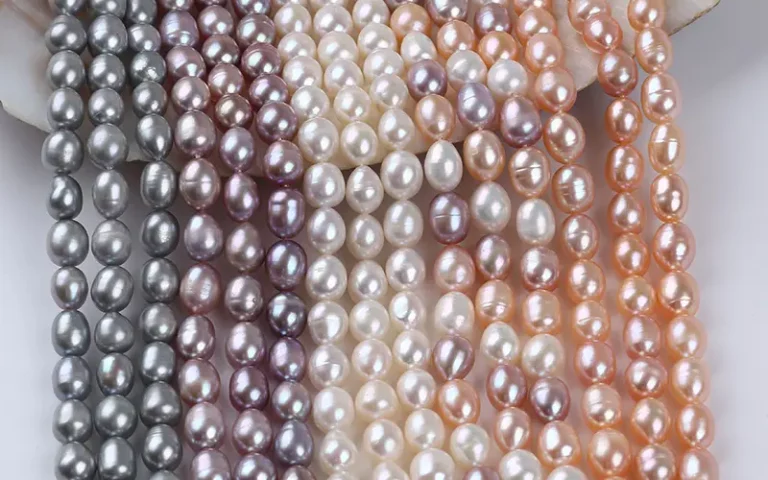
They come in limited colors, usually natural colors like white, pink, lavender, and peach. This is as a result of the mussel species and water conditions in which they originate from. Freshwater pearls have a softer, more subtle luster, with a natural glow. Their luster is more gentle and less reflective, giving them an understated beauty.
Durability
Shell Pearls:
Shell pearls are known for their high durability due to the rigorous quality control in the production process. The protective coatings and polishing ensure the pearls maintain their color and luster over time. They are capable of withstanding sweat, perfume, and environmental damage. Also, their synthetic nature makes them more resilient to wear and tear, meaning they can be used as everyday jewelry.
Freshwater Pearls:
Freshwater pearls are more delicate because they don’t have protective coatings like shell pearls. Over time, they may be affected by exposure to sweat, perfume, and environmental damage, which can cause their color and luster to fade. These pearls require more care to maintain their natural elegance.
Price
Shell Pearls:
These types of pearls are much cheaper than freshwater pearls due to their unnatural nature and controlled manufacturing process. The variety of sizes and shapes makes them a budget-friendly option for people who want natural pearls without the high cost.
Freshwater Pearls:
These pearls are generally more expensive than shell pearls, but still less costly when compared to saltwater pearls like Akoya or Tahitian pearls. The price of freshwater pearls varies depending on the size, luster, shape, surface, type of pearls, and nacre quality.
Conclusion
Shell pearls vs freshwater pearls is a popular debate among jewelry lovers. You can contact ColoritaJewelry——a professional custom jewelry manufacturer to get the type of pearl that aligns with your business needs more.
ColoritaJewelry is a leading expert in the field of enamel jewelry and inlaid jewelry design within the industry, known for our exceptional craftsmanship and unique designs. As both a wholesale supplier of enamel jewelry and a custom manufacturer of silver jewelry, we offer an extensive collection of pieces that cater to a wide range of tastes and preferences.