
Filigree inlay is a precious traditional technique in China, which has a long history and has been inherited from generation to generations. This art form involves creating intricate designs by weaving and inlaying thin strips of gold or silver into various objects. Below is the history of filigree inlay art and a detailed process of how these exquisite artifacts are made.
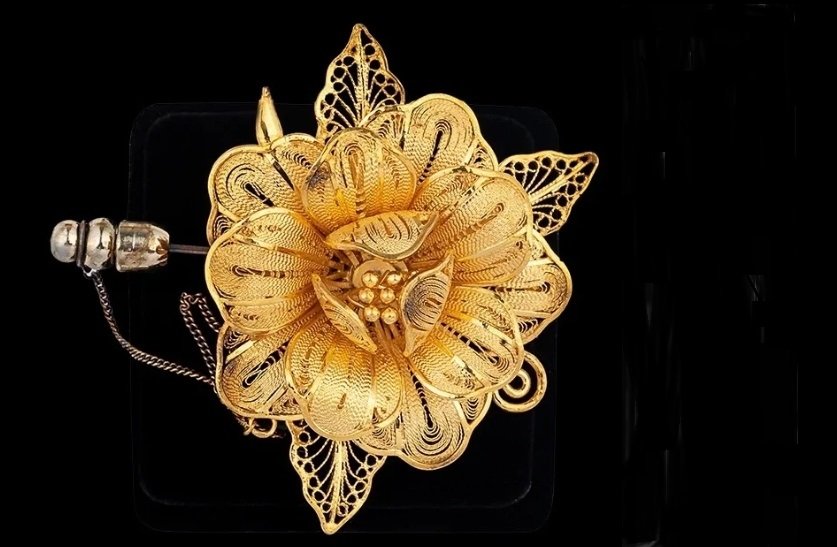
History of filigree inlay art
Filigree inlay art originated in the Warring States Period (475-221 BC). At the time, it was called“Jin Yin Cuo,”which involved painting gold and silver on the surface of bronze artworks. With the development of techniques for making thin gold and silver thread, which occurred around the Tang (618-907) and Song (960-1279) dynasties, filigree inlay art advanced in maturity.
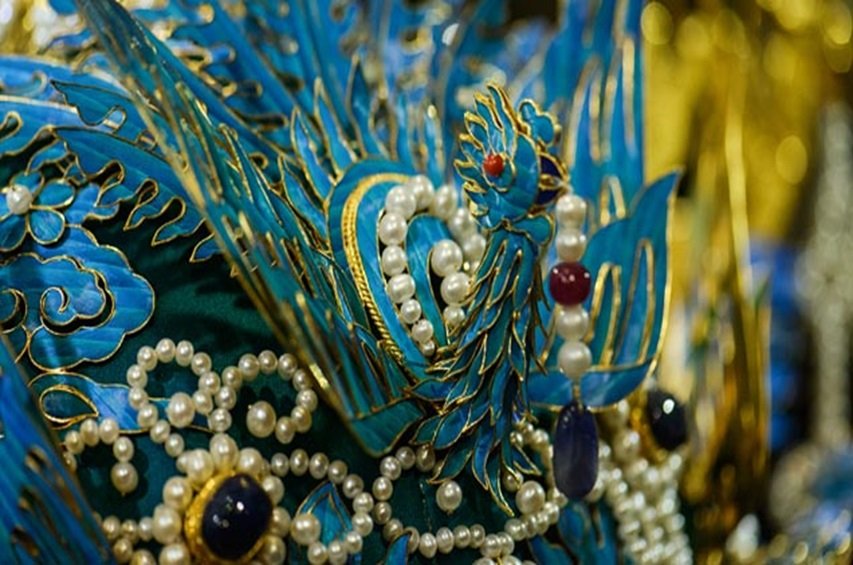
The Ming dynasty (1368-1644) was the golden age of filigree inlay art. Many masterpieces were created and inherited. Following the Ming dynasty, filigree inlay art reached its peak in the Qing dynasty (1644-1911). Qing was the last dynasty in China’s history. However, it was ruled by the minority group“Man“for over 260 years.
The art form developed by inheriting essential elements from the previous dynasties and adding new elements over time. Many filigree inlay pieces seen in a private art museum run by the premium jade jewelry brand, Zhaoyi, are replicas of masterpieces from Ming and Qing dynasties.
For a long time, filigree inlay artwork was controlled and appreciated only by royal families and the imperial class. Ordinary people were able to afford some products, but were prohibited from owning pieces bearing certain themes like the dragon and phoenix. Only the royal class could own the highest-quality materials and designs.
Social catastrophe at the end of the Qing dynasty meant the imperial family could no longer hold its position and afford luxury items. Many master goldsmiths escaped the palace to open their own businesses. For a while, many small-scale filigree inlay art studios and workshops were concentrated in southern Beijing, which once had been an area full of all kinds of craftspeople.
By the end of the 20th century, after the many social upheavals China had experienced over the previous 150 years, filigree inlay art was one of many cultural heritages that were fading away. Another reason why filigree inlay art is becoming increasingly difficult to develop is that in that era, wearing and owning fancy jewelry was considered offensive, and people at that time did not highly value it.
The drafting, internationally, of the concept of Intangible Cultural Heritage in the early 2000s made it possible for filigree inlay art to be picked up and passed along to future generations. (The concept of Intangible Cultural Heritage encompasses practices, knowledge, and skills that are recognized as part of a country’s or community’s cultural heritage.) As an Intangible Cultural Heritage of China, filigree inlay art has caught people’s attention and is being protected and passed along.
The following is an introduction to the process of some filigree inlay techniques.
Process of filigree inlay art
The following is an introduction to the process of some filigree inlay techniques. The art of filigree inlay, also called “fine gold art,” combines two craft skills. One is filigree,in this process needs gold or silver threads of different weights. The second component, inlay work, involves mounting the stones to the final product and carving or filing the precious metals. The craftsperson can use one or both skills when creating a piece.
Preliminary Preparation
Before embarking on the creation of filigree inlay artifacts, craftsmen must first perform the crucial step of drawing gold and silver into wire. This preliminary work is essential as it lays the foundation for the entire craft.
Drawing the Wire
- Tools and Materials: The process begins with a dedicated board, whose eye holes are meticulously crafted from alloy and diamonds. These holes range from as small as 0.2mm, thinner than a human hair, to as large as 4mm in diameter.
- Creating Elemental Filaments: The craftsmen skillfully pull the gold or silver through these tiny holes to create individual strands known as “elemental filaments.”
Crafting the Filigree
Once the elemental filaments are prepared, they are transformed into the intricate filigree designs through a series of skilled processes.
Pinching
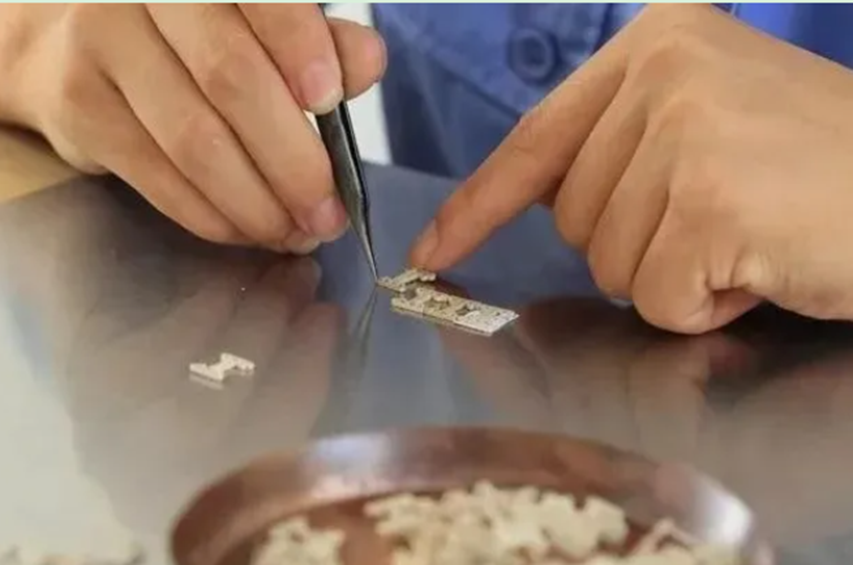
- Technique: This step involves the pure handmade process of using forceps or pliers to shape the elemental filaments into various patterns.
- Significance: Pinching is not only a basic skill but also the most challenging aspect of filigree inlay art.
Filling
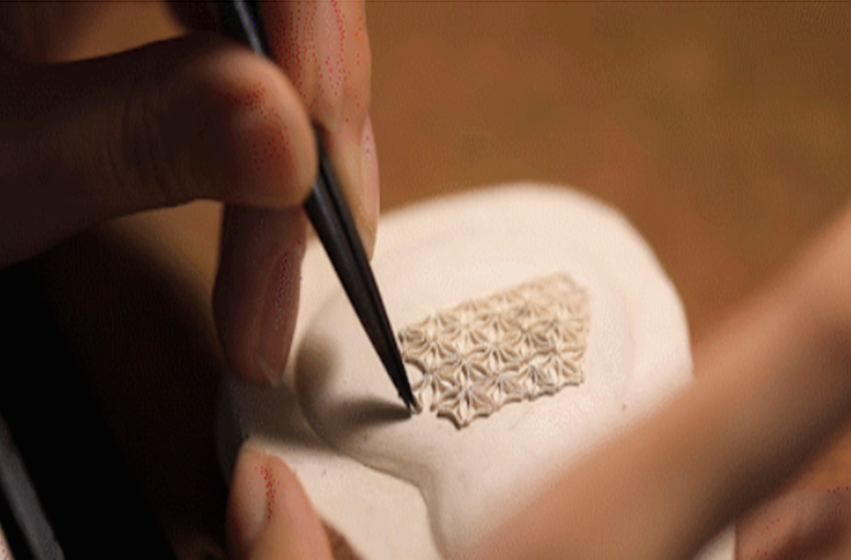
- Process: Unlike common perception, “filling” here refers to placing, not stuffing, the crafted filigree patterns into a predefined design.
- Characteristics: This step is often monotonous and time-consuming, yet it is crucial for achieving the desired aesthetic.
Stacking
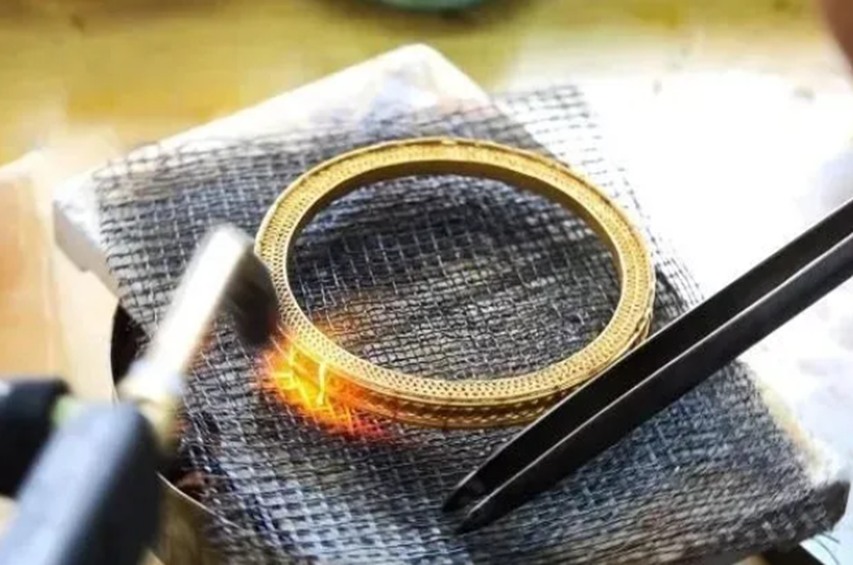
- Meaning: “Stacking” implies accumulation, where the craftsmen assemble the parts together in preparation for welding.
- Difference from Filling: Unlike the flat placement in filling, stacking involves three-dimensional assembly of components.
Welding

- Procedure: This step involves soldering the crafted patterns together to form a complete ornament.
- Outcome: Welding is the process that transforms individual components into a cohesive piece of art.
Heaping
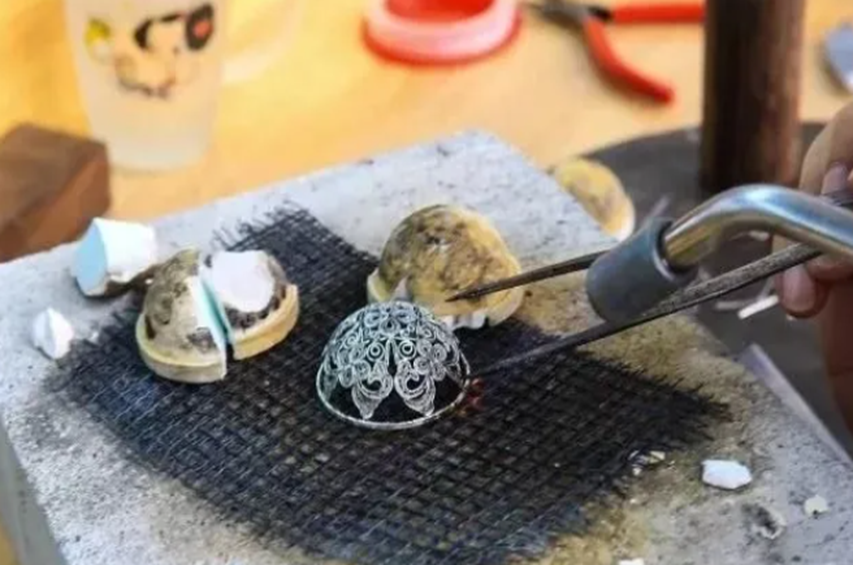
- Comparison: Similar to the “molding” process in porcelain making, heaping involves creating a base or mold on which the filigree work is constructed.
Weaving
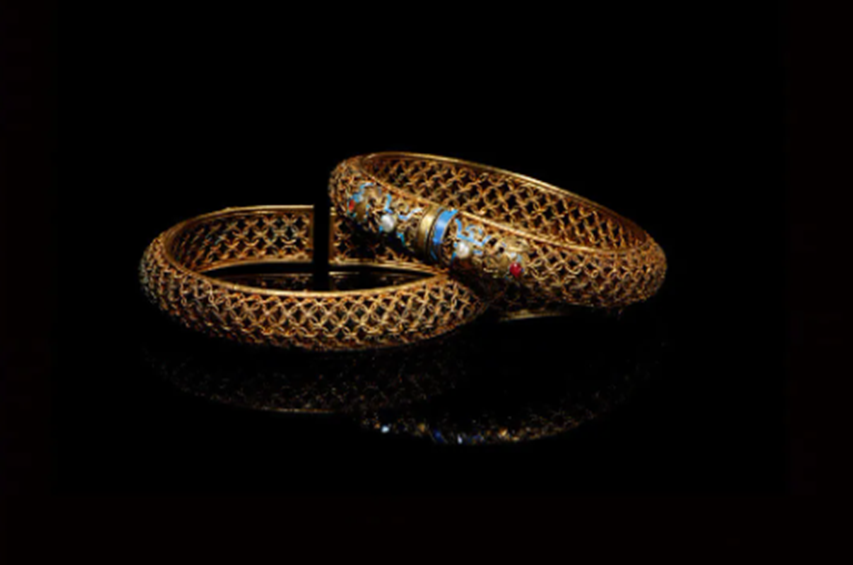
- In this process, two or more golden or silver wires will be woven into small braids and wire mesh, and then the small braids and the wire mesh will be woven on hair ornaments or other utensils.
Final Touches
After the main body of the artifact is complete, it is further enhanced with additional details.
Carving and Inlaying

- Decoration: The metal ware is carved with intricate patterns and inlaid with precious materials such as gems and pearls.
- Result: This final step adds a layer of sophistication and beauty to the artifact, making each piece truly unique.
Filigree inlay artifacts are not just objects but are a testament to the skill, patience, and creativity of the craftsmen. Each piece tells a story of tradition and craftsmanship, making it a cherished art form that continues to captivate and inspire.